Case study · Multi-campus hospital network
Northwell Health
The largest healthcare provider in New York State, with over 1,000 care facilities and 28 hospital campuses, turned to DaisyChain to solve a critical power-quality problem.
28
Campuses in Northwell's network
$1M/day
At stake per hospital
2,500+
Patients per event
The problem
Symptoms everywhere, root cause nowhere.
Several times a year, low-voltage alarms trip across Northwell's campuses and fire expensive back-up generators. As critical-care facilities, the hospitals run under an N+1 redundancy regime. Once a campus is on back-up power it is no longer at N+1, so it has to cancel or delay planned critical procedures.
Every event caused turmoil. Patient care was interrupted, procedures were postponed, and the network lost up to $1M per day per hospital. Northwell often had no idea what was triggering the alarms: something on site, or the utility failing to deliver power within its contracted voltage levels?
The solution
High-precision meters, one synchronized view.
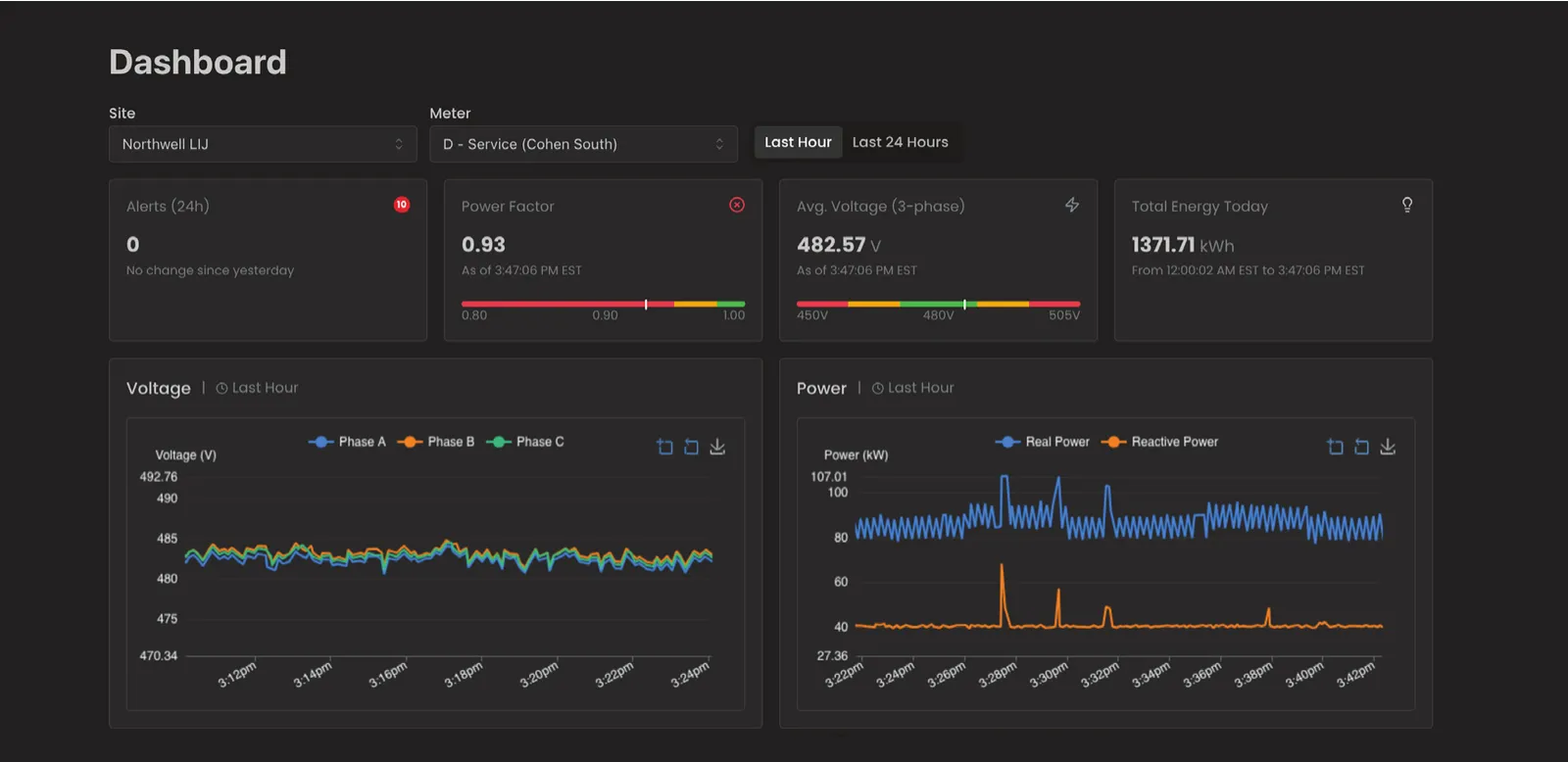
DaisyChain installed high-precision meters on critical loads across key campuses. The platform monitored and analyzed those loads in real time, giving a synchronized snapshot of every power-quality event.
The platform traced the voltage problems back to the utility and provided irrefutable evidence that the faults did not originate in Northwell's equipment. They came from poor-quality power on the grid. That let Northwell open data-driven discussions with the utility on improving delivery.
The playbook
A structured, evidence-based progression.
Northwell and DaisyChain are building an enterprise power-quality intelligence capability: from reactive, device-by-device troubleshooting to repeatable, system-level diagnosis and remediation. The approach unfolds in three phases.
- 01
Measure and diagnose
Synchronized monitoring at diagnostically meaningful points builds a time-aligned picture of every event: what happened, where it originated, and how it propagated. Correlating multiple points distinguishes upstream grid disturbances from internal contributors, with evidence.
- 02
Fix what the data shows
Invest based on measured conditions instead of guesswork, so capital goes to the fixes that reduce the events driving clinical disruption. On-campus DER becomes a power-quality and resilience tool, not just backup, and utility engagement is grounded in a shared evidence base.
- 03
Monetize without compromising care
Qualifying DER and load flexibility enroll in demand response and grid-services programs, converting resilience assets into recurring value. Measurement and verification are built in from the start, so revenue strategies complement clinical priorities rather than compete with them.
What comes next
This is just the first step.
A platform for the whole electrification pathway.
Peak shaving
Lower electricity costs as control functionality comes online across campuses.
Demand response
Access to utility DR programs for new operating revenue.
On-site generation
Solar and fuel cells, integrated and optimized for the highest value.
Battery storage
Batteries optimized across campuses for backup, peak shaving, and demand response.
Fleet electrification & EV charging
As Northwell electrifies its vehicle fleet and adds on-site charging, DaisyChain is engaged to integrate both onto the platform, so every new load is monitored and optimized alongside the rest.
Northwell and DaisyChain co-authored a joint white paper, “Unified Power Quality Intelligence for Hospital Campuses,” available on request.
“Northwell Health has found DaisyChain to be among the most innovative and insightful of organizations. The breakthrough platform they are developing will provide the means to communicate with the grid in transition, while maximizing patient safety through enhanced hospital/utility intelligence.”